The Orchestration Programming Interface — the programming interface for intelligence that coordinates.
August 17, 2026
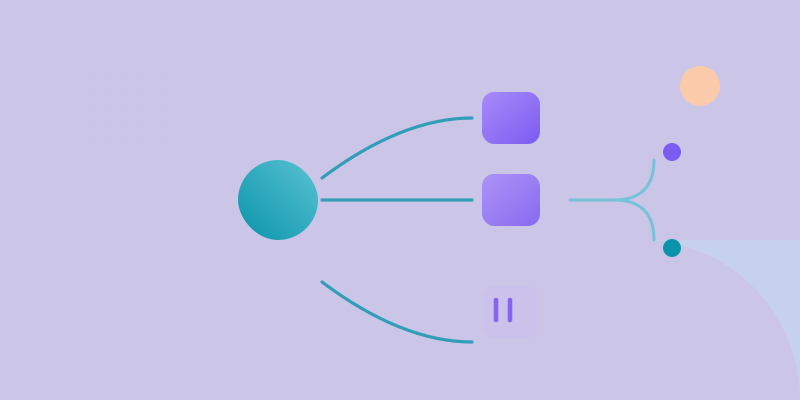
An Orchestration Programming Interface (OPI) is a programmable interface through which intelligence creates, modifies, governs and observes orchestration. An API might say: call this model, retrieve this file, execute this function. An OPI expresses something larger — coordinate these participants, delegate this work, establish the hierarchy, reconcile their outputs, and govern how the resulting intelligence moves through the system. It is the programmable control layer of AI Orchs.
Labsintelligence · lab1 of Labs Octra predicts · OPI expresses · AI Orch executes
The division of labor. An Octra does not need to know what runs beneath the verbs. It generates orchestration policy; the OPI turns policy into programmable operations; and the live object those operations produce and govern is the AI Orch. Spoken, this work arrives as Speech‑to‑Orchestration Voice Commands — the unit of spoken coordination an STO Model interprets, the twin of the Speech‑to‑Action Voice Commands the IPI carries.
01The verbs are the lifecycle
The published definition of an AI Orch already names its lifecycle: it can be created, modified, paused, resumed, forked, observed and completed. Those verbs, made callable, practically are the OPI:
Two of them carry the philosophy. requireApproval makes human confirmation a first-class orchestration step rather than an interruption — a held orchestration is a legitimate state, not a failure. And reconcile is the payoff of coordination itself: several participants’ outputs resolved into one answer, with agreements stated once, disagreements named plainly, and gaps admitted rather than papered over.
02Three roles, cleanly cut
Octrapredicts orchestration — which intelligence, what order, what runs in parallel, when to escalate. Its output is policy.OPIexpresses and manipulates orchestration — policy becomes callable operations with governance on every one.AI Orchexecutes orchestration — the live coordination object with participants, dependencies, state, receipts and a lifecycle.
OPI is the programming interface for intelligence that coordinates.
03The first generation
The first-generation OPI runs in LabsAI Studio. Its coordination substrate was already live — a six-stage governance gate on every operation, per-session capability scopes and budgets, background jobs that never hold the conversational floor — and the interface now stands on top of it: all fifteen verbs are callable, an orchestration is an addressable object with receipts on every transition, approval holds are real states, a paused orchestration survives the session and resumes in the next one, and forked orchestrations run independently of their parent. In speech, three spoken handles carry the whole interface — run, control, status — because voice tempo should never have to pronounce fifteen verbs. And an orchestration’s spec is a document: saveable and loadable as an A2F .spec, so the same coordination can run again from a file.
How the coordinated work travels between intelligences is the protocol’s story.
Contributing authors: Maya E. Davis · Duránd F. Davis Jr.
Tell us what you think, join us
This research is published while the questions are still open, and the systems it describes are live. We would love for you to join us — and please share your thoughts at research@labsintelligence.ai.
Citation
Please cite this work as:
Davis, Maya E., and Davis, Duránd F., Jr., “Introducing OPI.” LabsAI Research Briefs, Labsintelligence — lab1 of Labs Companies, Inc., August 2026.
Or use the BibTeX citation:
@article{labsintelligence2026introducingopi,
  author  = {Davis, Maya E. and Davis, Duránd F., Jr.},
  title   = {Introducing OPI},
  journal = {LabsAI Research Briefs},
  publisher = {Labsintelligence, lab1 of Labs Companies, Inc.},
  year    = {2026},
  month   = {august},
  url     = {https://labsintelligence.ai/research/labsai/introducing-opi/},
}